Ever bought a fragrance that lasted all day but barely anyone could smell? Or one that smelled incredibly strong at first but disappeared a few hours later?
That’s where three important fragrance terms come in: projection, sillage, and longevity.
You’ll see them mentioned in almost every perfume review. They’re often confused, but each describes something different about how a fragrance performs.
Here’s what they actually mean.
Projection: How Far Can People Smell Your Perfume?
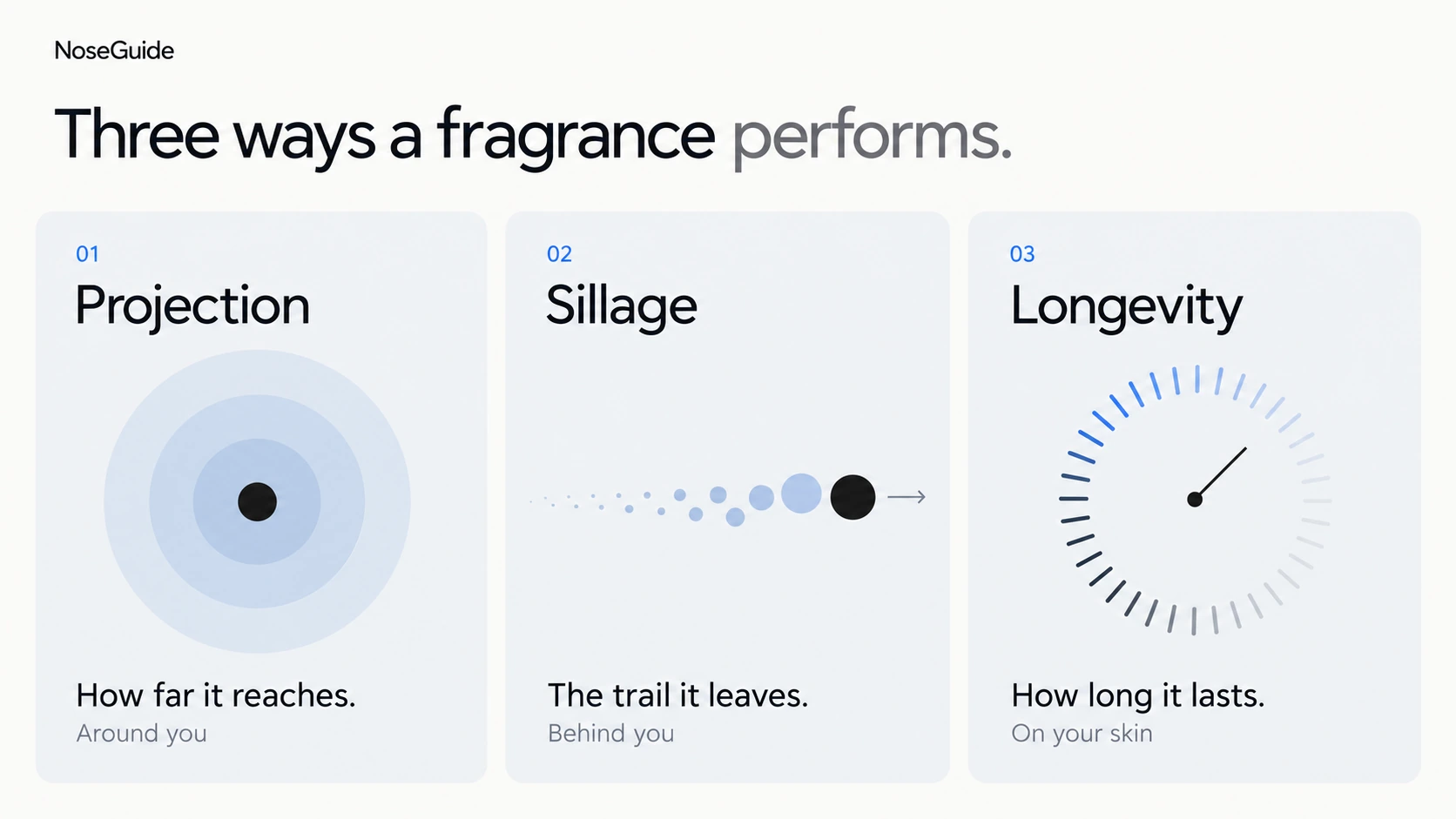
Projection is how far a fragrance can be smelled from your body.
Imagine standing next to someone. If they can smell your perfume without leaning closer, your fragrance has noticeable projection.
Some perfumes can be detected from several feet away, while others stay much closer to your skin.
Projection isn’t constant, though.
A fragrance might project strongly during the first hour and gradually become softer as it develops. Eventually, it may only be noticeable when someone gets close to you.
That doesn’t mean the fragrance has disappeared. It’s simply projecting less.
Sillage: The Scent Trail You Leave Behind
Sillage (pronounced see-yahzh) is the scent trail your perfume leaves as you move.
Think about walking past someone and noticing their fragrance even after they’ve moved away.
That’s sillage.
The word comes from French and refers to the trail a boat leaves behind as it moves through water.
The main difference between projection and sillage is simple:
Projection is how far your fragrance reaches around you. Sillage is the trail it leaves behind.
They’re closely related, but they’re not exactly the same.
A fragrance might be quite noticeable when you’re standing next to someone without leaving a particularly strong trail as you walk away.
And like projection, sillage can change depending on the fragrance, temperature, and airflow.
Longevity: How Long Does Your Perfume Last?
Longevity describes how long a fragrance remains detectable on your skin.
For example, if you apply a perfume at 9 AM and can still smell it at 5 PM, you’re getting around eight hours of longevity.
But here’s something worth knowing.
A perfume that lasts eight hours doesn’t necessarily project strongly for eight hours.
It might have noticeable projection for the first couple of hours, then gradually settle closer to your skin for the rest of the day.
That’s still good longevity.
This is why you shouldn’t judge a fragrance’s lasting power only by how strongly you can smell it in the air.
Projection vs. Sillage vs. Longevity at a Glance
| Term | What It Means |
|---|---|
| Projection | How far people can smell your perfume |
| Sillage | The scent trail you leave as you move |
| Longevity | How long your perfume remains detectable |
Here’s a simple example.
Imagine two fragrances.
The first projects strongly and gets noticed immediately, but after three hours, it’s almost gone.
The second stays fairly close to your skin, but you can still smell it eight hours later.
The first has stronger initial projection. The second has better longevity.
Neither is necessarily the better perfume. It depends on what you enjoy wearing.
What Actually Affects Fragrance Performance?
There’s a reason the same perfume doesn’t perform identically on everyone.
The fragrance itself matters most. Its ingredients and overall composition influence how quickly different aromatic materials evaporate and how noticeable they are in the air.
Skin conditions, temperature, and airflow can also affect how the fragrance behaves.
And what about concentration?
An Eau de Parfum or Extrait doesn’t automatically perform better than an Eau de Toilette. A higher concentration may help with lasting power, but the formula matters just as much.
Want to understand why? Read our guide to EDT vs. EDP vs. Parfum vs. Extrait.
Why Can’t You Smell Your Perfume After a While?
This is something almost everyone experiences.
You apply your favorite fragrance, enjoy it for a couple of hours, and then suddenly you can barely smell it.
Before assuming it’s gone, remember that your nose can get used to a scent after continuous exposure.
It’s called olfactory adaptation, often referred to as nose blindness.
Your perfume may still be noticeable to others even when you struggle to detect it yourself.
Of course, sometimes the fragrance really has faded. Both are possible.
A simple way to check is to ask someone else before reaching for another few sprays.
How to Test Projection, Sillage, and Longevity
The easiest way is to wear the fragrance during a normal day rather than judging it immediately after spraying.
For longevity, check how it smells on your skin after two, four, and six hours. See how long it remains detectable, even up close.
Projection and sillage are a little harder to judge alone.
Ask someone whether they can smell your fragrance at a normal conversational distance. You can also ask if they notice a scent trail when you walk past.
Try the same fragrance on different days. One test won’t always tell you the whole story.
Which Matters Most?
There’s no universal answer.
For the office, you might want something that lasts several hours without being too noticeable to everyone around you.
For a night out, stronger projection and a more noticeable scent trail might be part of what you enjoy.
A fragrance doesn’t have to be loud to perform well.
A perfume that smells beautiful and stays close to your skin can be just as enjoyable as one that gets noticed immediately.
The best performance is the one that suits how and where you want to wear your fragrance.
Frequently Asked Questions
Does strong projection mean good longevity?
No. A perfume can project strongly at first but fade relatively quickly. Another can last for hours with very little projection.
Does spraying more perfume make it last longer?
More sprays can make a fragrance more noticeable, especially initially, but they won’t necessarily extend how long the formula lasts on your skin. Too many sprays can also become overwhelming.
What is a skin scent?
A skin scent is a fragrance that stays very close to your body. It’s usually noticeable only when someone gets near your skin, even though it may last for several hours.
Find Your Next Fragrance on NoseGuide
Now that you know the difference between projection, sillage, and longevity, choosing a fragrance becomes a little easier.
Explore fragrances on NoseGuide, compare their scent profiles, and discover fragrances with similar scent profiles to the perfumes you already love.